NG-2201 · 8 Jan 2026
“We will refund the £120 to your card by Friday.”
Written to a customer from a shared inbox. Confirmed by a named reviewer.
review due 2 Mar 2026
Nothing was recorded to say it was kept. 242 days open.
From the seeded demonstration account. No real customer appears anywhere on this page.
An agent promised a refund. Nobody told legal.
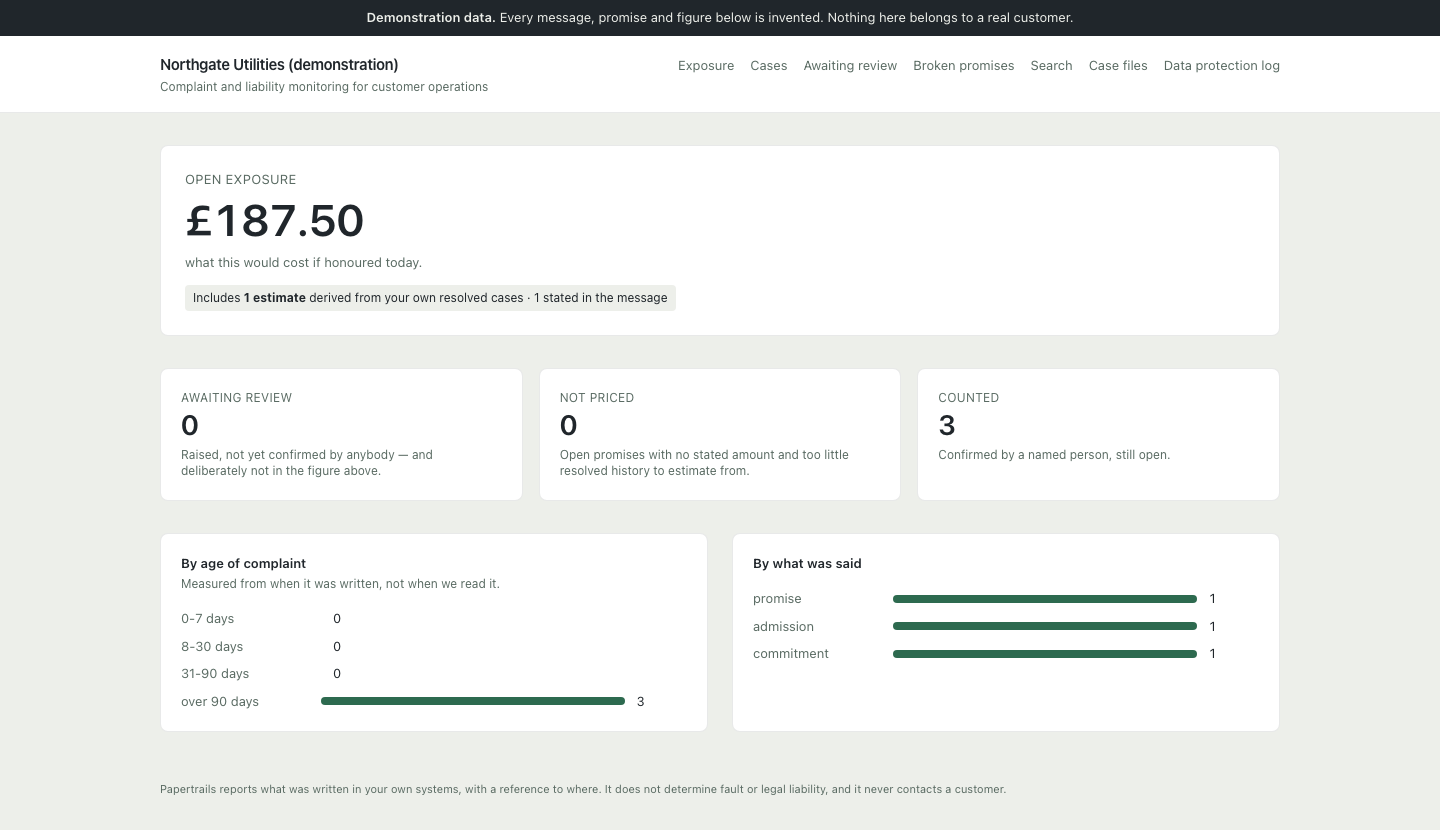
Papertrails reads what your team writes to customers, and finds every promise and admission before it becomes a claim. You get a running total of what you’re on the hook for, updated as it happens.
read, typed and priced
the gap
The job nobody owns.
Every support team makes promises in writing, all day, without meaning to.
An agent tells a customer
“we’ll waive that fee.”
Another writes
“you’ll have a refund by Friday.”
Someone replies to an angry email, copied to a solicitor, with
“we accept this was our error.”
None of this goes through anyone senior. It goes out the moment someone hits send.
Right now, nobody reads this traffic until it becomes a problem. The complaint sits in a shared inbox that three people check, or in one person’s inbox that nobody else can see. If a customer escalates, someone has to search the thread by hand and hope the agent didn’t say something they shouldn’t have.
If a solicitor’s letter arrives quoting an email, the letter is often the first anyone hears of the promise underneath it. By then it isn’t a customer service problem. It’s a legal one, and it’s already been decided by someone who wasn’t authorised to decide it.
This job has no owner today. Helpdesk software logs the ticket, but nobody reads it for risk. Legal case tools exist for once a claim is already open. The gap in between, where the promise gets made and sits unread, is where this product works.
Read, typed and priced, the same three sentences look like this.
the method
Four steps, and a record at the end of them.
step 1 of 4
It reads your shared inboxes and chat transcripts.
Complaints@, support@, and the platforms your team already uses. It never touches a personal inbox, and it never listens to a phone call.
step 2 of 4
It finds the sentences that create exposure.
A promise, an admission of fault, or a commitment to a date or an amount. Each one gets flagged the moment it’s written, not weeks later.
step 3 of 4
It checks whether the promise was kept.
It watches for the matching action, a refund appearing in your billing system, a callback logged, a case closed. If the date passes and nothing matches, it tells you.
step 4 of 4
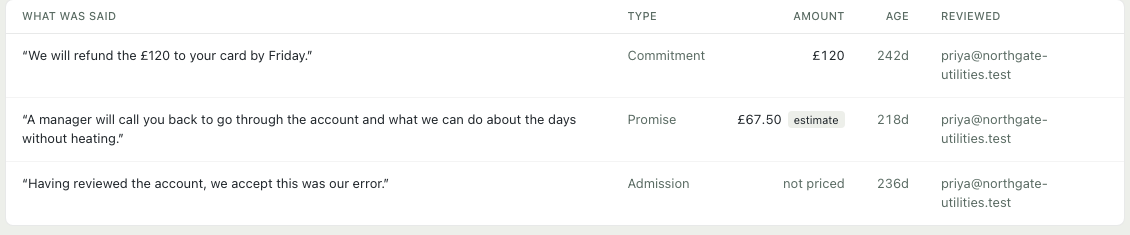
It adds the open ones into one number.
Every unresolved promise or admission, priced where a figure exists, estimated and marked as an estimate where it doesn’t. That’s the number you take to the board.



the terms
Why the record stands up.
A product that reads a company’s complaint history has to be trusted by the people whose names are on those messages. These are the limits, and they are enforced where a caller cannot talk their way around them.
never contacts
Papertrails never contacts a customer. It drafts nothing that goes out without a named person reviewing and sending it first.
never judges
It never tells you what a promise means legally. It shows you exactly what was written, in order, and leaves the judgement to General Counsel.
always traceable
Every figure on screen traces back to something real: an amount stated in the message, an account’s value, or a cost from that company’s own past resolved cases. Where there’s no figure to trace, it says “estimate” next to the number, on the screen, not buried in a footnote.
always logged
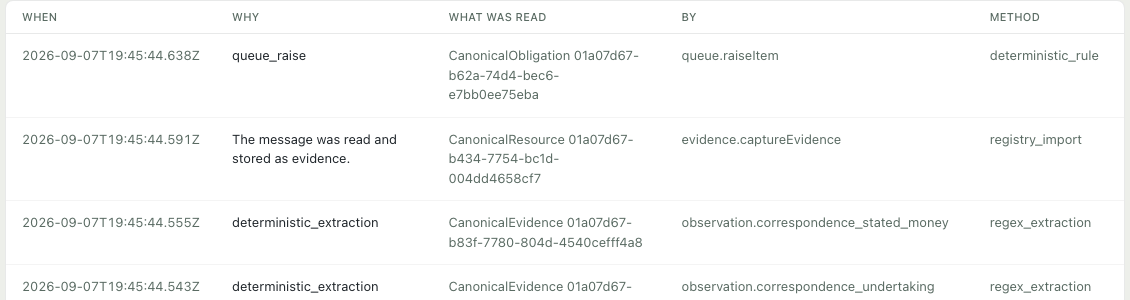
It keeps a log of every message it read and why. That log is built for your data protection officer, not as an afterthought.
shared inboxes only
It starts with shared and role inboxes only. Personal mailboxes carry a heavier data protection burden, and sometimes need sign-off from a works council, so they’re deliberately out of scope until that’s in place.
Each of these is enforced in the code, not stated in a policy document. The log below is the one your data protection officer reads.
the sources
It reads the systems the conversation already happened in.
- Microsoft 365
- Shared and role mailboxes — complaints@, support@ — read through Graph.
- Google Workspace
- The same shared and role mailboxes, read through Gmail’s own equivalent.
- Chat transcripts
- Transcripts from the support platforms your team already talks to customers in.
A shared mailbox is a shared mailbox whichever system it lives in, so the provider is recorded separately from the kind of source. Personal mailboxes are out of scope by construction, not by configuration.
the price
One plan. The price follows the volume.
$1,200 – $4,000 / month
| What moves it | Nearer $1,200 | Nearer $4,000 |
|---|---|---|
| Inboxes connected | One or two shared mailboxes in a single team. | Several role mailboxes across support, billing and complaints. |
| Messages read a month | Thousands. | Tens of thousands, with chat transcripts alongside mail. |
| People using it | One owner in operations or legal. | A team of reviewers, with the log audited regularly. |
Included at every price
There is one plan, so nothing is held back for a higher one.
- Every connector: Microsoft 365, Google Workspace and chat transcripts
- Every promise, admission and commitment found, with no cap on flags or cases
- The exposure total, with each figure traceable to the message or the resolved case behind it
- Sealed case files, hashed on every page, stating what was withheld and why
- The full data protection log, auditable by your officer at any time
Larger organisations sit above this band; we’ll tell you honestly if that’s you.
There’s no self-serve signup and no card on file. It’s sold the way a compliance tool should be: by a call, with someone who can answer what it does and doesn’t do.
next
We’ll tell you what it would cost, and what it would find.
Tell us how many inboxes you run and roughly how many messages a month go through them. We’ll tell you what it would cost and what it would find, before you commit to anything.
- What we’ll ask
- How many shared inboxes you run, and roughly how many messages a month go through them.
- What you’ll get
- What it would cost for your volume, and what it would find in your traffic.
- What it commits you to
- Nothing. No card, no trial to cancel, and no signup that starts a clock.
- Who reads your mail
- Nobody, before you connect anything. The demonstration runs on invented data.
asked
Common questions.
- What data does Papertrails actually read?
- Shared and role inboxes, like complaints@ or support@, connected through Microsoft 365. Chat transcripts from the support platforms you already use. Nothing from personal mailboxes, and nothing from phone calls unless a transcript already exists elsewhere.
- What happens when it flags something that isn’t real?
- It happens, and it’s designed for that. Every flag is reviewed by a person before anything is sent, escalated, or reported upward. A wrong flag costs someone thirty seconds to dismiss. A missed promise costs a lot more.
- Does it ever contact our customers directly?
- No. It reads and flags. A named person on your team decides what happens next, and sends anything that goes out themselves.
- Can it read personal mailboxes?
- Not yet, and not without the right safeguards in place first. Personal mailboxes carry a higher data protection burden, and in some organisations need agreement from a works council. This is deliberately built for shared and role inboxes only, to start.
- How do you calculate the number on the dashboard?
- By adding up the rough cost of every open flagged promise or admission. Where an amount is stated in the message, we use it. Where it isn’t, we estimate from that company’s own past resolved cases, and mark it clearly as an estimate, not a fact.
- What does our data protection officer need to sign off?
- A record of exactly what was read and why, which the product keeps automatically and which your officer can audit at any time. Most legal teams want to see this log before anything else.